
Why Treating Every Content Type the Same Is Costing Organizations Time, Money and Quality
 Ciklopea Consulting */ ?>
 Artificial intelligence has made multilingual content easier to create and process than ever before. Yet many organizations still manage fundamentally different types of content through essentially the same localization workflow. That approach increases cost, slows delivery and creates unnecessary risk.
The hidden assumption behind most multilingual operations
Over the past two decades, organizations have invested significantly in making multilingual communication more efficient.
They have implemented Translation Management Systems (TMS), built translation memories and terminology databases, established review processes, introduced machine translation and, more recently, started experimenting with generative AI.
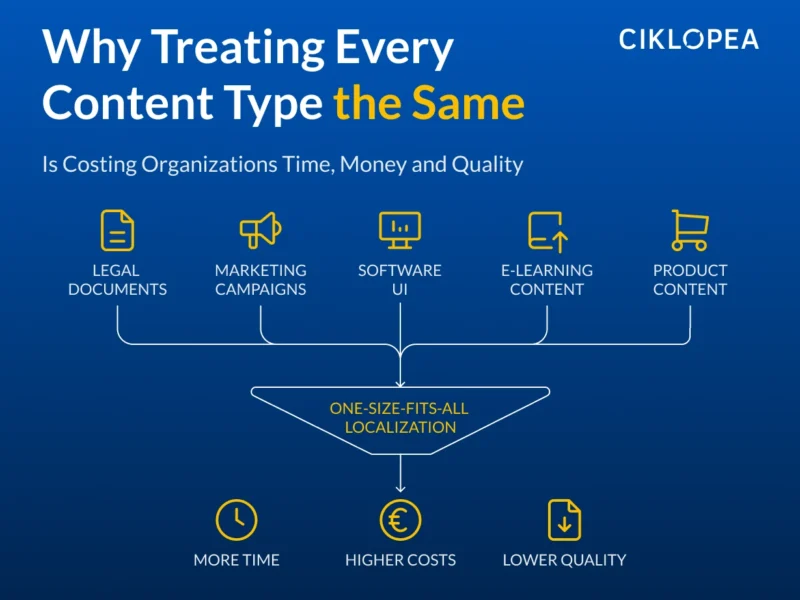
These investments have improved productivity and made multilingual operations considerably more scalable. Yet one important assumption has often remained unchanged: Every piece of multilingual content is managed as though it deserves approximately the same operational treatment.
Different languages. Different markets. Different business objectives. Often the same workflow.
Content is submitted for translation, processed using a predefined combination of technology and linguistic resources, reviewed, approved and published. For years, this standardization was a reasonable way to maintain control over increasingly complex multilingual operations. In the AI era, however, it is becoming an expensive limitation.
The issue is not that standardized processes are inherently inefficient. Standardization remains essential for quality, consistency and governance. The problem is standardizing the wrong part of the process.
Organizations need consistent governance, terminology and quality principles. They do not necessarily need identical workflows for every type of content.
Not all multilingual content creates the same business consequences
Consider six common examples:
- medical device Instructions for Use
- a product launch campaign
- a customer support article
- an internal HR announcement
- an investor presentation
- a social media post
All require multilingual communication. All create business value. But the consequences of an error differ significantly.
A terminology inconsistency in a social media post may affect brand perception. The same inconsistency in regulated product documentation could create a compliance issue, introduce ambiguity for the user or delay market access.
A slightly unnatural sentence in an internal announcement may be inconvenient but manageable. Ambiguous wording in a contractual clause may create legal or commercial consequences.
A customer support article presents a different challenge again. Individual errors may carry relatively limited risk, but outdated or inaccurate articles replicated across thousands of customer interactions can increase support volumes and reduce customer satisfaction.
This distinction matters because quality requirements should reflect business consequences, not simply content volume or language pair.
A practical example: three content types, three appropriate workflows
Imagine a medical technology company preparing multilingual content for a new product. It needs to localize three types of content.
The first is the product’s Instructions for Use. This content may require approved terminology, subject-matter linguists, controlled translation memory, documented review, regulatory validation and complete traceability of changes. AI and machine translation may support specific stages, but the workflow must remain governed by the regulatory requirements and risk profile of the content.
The second is a series of product marketing pages. Accuracy and terminology still matter, but the objective is different. Brand consistency, readability, market relevance and time-to-market become more prominent. AI-assisted translation combined with expert linguistic review may provide the appropriate balance.
The third is a set of internal project updates for employees. Here, speed may matter considerably more than stylistic refinement. A securely deployed AI workflow, supported by approved terminology and appropriate data governance, may be sufficient without requiring the same level of human review.
One company. One product. Potentially the same target languages. Three different operational models.
Applying the regulatory workflow to all three categories would create unnecessary cost and delay. Applying the internal communication workflow to all three would create unacceptable risk.
The efficient solution is not maximum automation or maximum human review. It is appropriate control.
AI amplifies both efficiency and mistakes
Artificial intelligence has dramatically reduced the effort required to produce multilingual content. That creates significant opportunities for organizations managing large content volumes.
AI can support translation, terminology extraction, content classification, quality checks, summarization, linguistic review and workflow orchestration. Combined with machine translation, translation memories and structured terminology, it can accelerate multilingual operations considerably.
But AI scales more than productivity. It also amplifies the critical need for decision-making. While it may seem that way, AI doesn’t make translation easier.
Consider an organization with a knowledge base containing 20,000 support articles across 15 languages. If an unsuitable translation process affects one article, the impact is limited.
If automation applies the same unsuitable process to the entire repository, the problem becomes systemic. Incorrect terminology, outdated instructions or misleading product information can propagate across markets before a human reviewer sees the first example. The economics of localization have therefore changed, and so have the economics of error.
Organizations can now produce multilingual content faster than their traditional review structures can realistically inspect it. This means the central AI question is no longer simply: “Is the technology accurate enough?”
A more useful question is: “Under which conditions is this level of automation appropriate?”
That requires understanding the content before selecting the technology.
The problem isn’t language
It’s decision making.
Multilingual operations have traditionally been organized around languages. French. German. Spanish. Japanese.
Operational decisions often followed target markets, linguistic resources, vendor capacity and translation volumes. Those factors still matter. But another variable is becoming increasingly important: the business context of the content itself.
Two assets translated from English into German may require entirely different levels of human involvement, quality assurance and governance. A German regulatory submission and a German internal newsletter share a language pair. Operationally, however, they have very little in common. Conversely, a technical support article translated into German, French and Italian may follow the same workflow because its purpose, risk level, content structure and quality requirements are consistent across those markets.
This leads to an important principle: Language determines linguistic requirements and content context determines operational requirements.
Effective multilingual operations need to manage both.
Efficiency without differentiation creates hidden costs
When every content type receives the same operational treatment, organizations usually encounter one of two problems.
The first is over-engineering. Low-risk content receives extensive human review even when speed and scalability matter more than linguistic refinement.
Imagine a global technology company publishing 500 minor knowledge-base updates every month. If every update requires translation, linguistic review, internal market review and final approval across ten languages, the organization creates thousands of review actions each month.
The question is not whether those reviews improve quality. Some undoubtedly do. The relevant question is whether the improvement justifies the cost and delay for every piece of content. If the answer is no, review capacity is being consumed where it creates limited business value.
The second problem is under-engineering. High-impact content receives insufficient oversight because it follows the same automated workflow as lower-risk material. A process optimized for product descriptions may be entirely inappropriate for safety instructions, contractual content or regulated labeling.
Neither outcome creates value; one consumes resources unnecessarily, the other creates avoidable risk, and both reduce organizational agility. Organizations may believe they are standardizing quality when, in practice, they are standardizing effort regardless of business impact.
The future belongs to differentiated workflows
Mature multilingual operations increasingly resemble portfolios rather than production lines.
Different categories of content require different combinations of:
- human expertise
- machine translation
- generative AI
- translation memory
- terminology management
- automated quality assurance
- subject-matter review
- regulatory validation
- workflow automation
- data and AI governance
The objective is not to build one localization process that performs adequately in every situation. It is to establish a structured operating model that selects the appropriate process for each situation.
That shift affects more than translation. It influences budgets because organizations can direct specialist review toward higher-impact content. It affects technology decisions because tools are selected according to specific operational requirements rather than deployed indiscriminately. It strengthens governance because teams can define where automation is permitted, where human approval is mandatory and how exceptions are handled. It improves scalability because increasing content volumes no longer require human review to increase at exactly the same rate. Most importantly, it connects multilingual operations directly with business objectives.
From translation management to multilingual communication management
For many years, the language industry focused primarily on improving translation production.
Translation memory reduced repetitive work. Terminology management improved consistency. Machine translation increased throughput. Translation Management Systems improved workflow coordination.
These developments remain essential, but organizations are now operating in a different environment.
Content is continuously created and updated across websites, product platforms, support systems, learning environments, content management systems and internal communication channels. AI further accelerates that production. The challenge is therefore larger than translation.
Organizations need to decide what content should be localized, how quickly, using which technology, with what level of human expertise, under which governance rules and according to which definition of quality.
That is not simply translation management. It is multilingual communication management. The distinction matters because it changes the role of the localization function.
Instead of primarily coordinating translation production, multilingual teams increasingly become responsible for designing the rules that determine how content moves safely and efficiently across languages, technologies and markets.
Their value shifts from processing content to orchestrating multilingual assets.
A different question for leadership teams
Executives considering AI in multilingual operations often begin with a reasonable question: “How much of our content can AI translate?” The answer can produce useful estimates about automation and cost. But it does not provide an operating model.
A more valuable question is: “Which content deserves which operational approach?”
That question forces the organization to consider business impact, risk, quality requirements, technology, human expertise and governance together. Only then does it make sense to ask how much can be automated. This distinction becomes increasingly important as AI capabilities improve.
Organizations that classify their content and design differentiated workflows can automate where automation creates measurable value, while preserving specialist human involvement where judgment, precision and accountability remain essential.
The result is not simply lower localization cost. It is better allocation of expertise, faster multilingual delivery, stronger risk management and a more scalable foundation for international growth.
Because effective multilingual communication has never required applying the same process everywhere. It requires applying the right level of expertise, technology and control where each creates the greatest value.
Artificial intelligence has made that principle much more important.
Coming next
In the first article of this series, we explored why AI has transformed multilingual communication from a translation challenge into an operational one.
This article examined the next consequence: why organizations can no longer afford to treat every type of multilingual content in the same way.
The next installment addresses a related challenge in enterprise AI adoption: Why implementing AI without understanding content is like building a motorway without traffic rules.
We will examine how organizations can develop a structured understanding of their multilingual content before deciding where AI, automation and human expertise should be applied.
About the Multilingual Intelligence Initiative
This article is part of the Multilingual Intelligence Initiative, a Ciklopea thought leadership series examining how organizations can build responsible, AI-enabled multilingual communication capabilities.
Future articles will explore content risk, multilingual governance, AI operating models and the evolving role of multilingual communication as a strategic business function.