
AI Without Governance Is Just Faster Chaos
 Ciklopea Consulting */ ?>
Artificial intelligence doesn’t remove the need for governance. It makes governance one of the most important organizational capabilities. But responsible AI requires more than good technology.
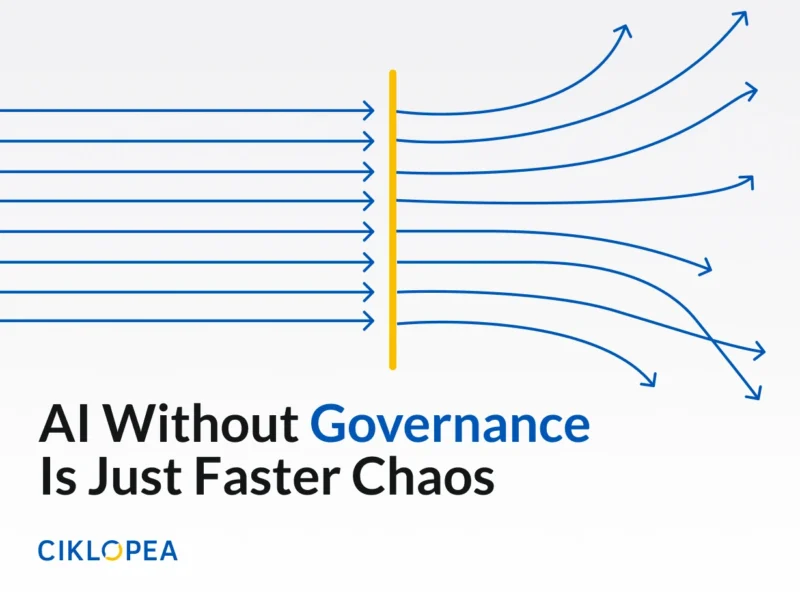
Organizations do not have an AI problem. They have a decision-making problem. Artificial intelligence can now draft, translate, summarize, adapt and classify multilingual content at a scale that was difficult to imagine only a few years ago. That changes the economics of multilingual communication. It does not change the need for accountability. In fact, it makes accountability more important.
When production becomes faster, organizations make more operational decisions in less time. More content moves through more systems. More teams gain access to AI capabilities. More outputs can reach customers, employees and markets before traditional review processes have time to respond.
The central question therefore changes. It is no longer simply: Can AI perform this task? It becomes: Under what conditions should AI perform this task, who has the authority to decide, and what evidence shows that the process remains under control?
That is a governance question. And it is becoming one of the defining questions of multilingual operations.
AI compresses the distance between decision and consequence.
Traditional multilingual workflows created natural friction. Content was prepared. Sent for translation. Reviewed. Approved. Published.
That friction was not always efficient. But it created time for decisions to become visible. AI changes that operating rhythm. A connected system can generate multilingual content, apply terminology, route it through automated quality checks and publish it across multiple markets with limited human intervention. The operational advantage is obvious, but so is the governance challenge.
When the interval between instruction and publication becomes minutes rather than days, organizations have less time to discover if the wrong model was used, the wrong terminology was applied, an approval was bypassed or a policy no longer matched the business requirement.
Speed therefore changes the nature of control. Governance can no longer depend exclusively on people noticing problems before publication. Controls increasingly need to be designed into the workflow itself.
Good governance starts with decision rights.
Many organizations begin AI governance with policies. But policies alone do not govern. Governance starts when people know who has the authority to make which decisions, and who is accountable for the outcome.
Consider a multilingual AI workflow. Who can approve a new AI provider? Who can authorize its use for regulated content? Who decides whether human review is mandatory? Who owns approved terminology? Who determines whether an output meets the required quality threshold? Who can accept an exception? Who stops the workflow when performance deteriorates? Who approves restarting it?
These are decision rights. When they are unclear, accountability becomes so distributed that it effectively disappears.
A localization manager may assume Information Security approved the technology. Information Security may assume Legal defined acceptable use. Legal may assume the business owner understands the content risk. The business owner may assume the language solutions provider is responsible for quality.
That last assumption deserves particular scrutiny. A capable language solutions provider does far more than check the final output. We bring the linguistic expertise, quality frameworks, workflow knowledge, and multilingual risk perspective needed to help define what good looks like, where human judgment matters, and when a workflow should not proceed.
Everyone may be involved. But involvement is not ownership. Effective governance makes decision rights explicit, places accountability where the expertise sits, and removes ambiguity before it becomes risk.
Responsibility must exist at several levels.
AI-enabled multilingual operations depend on clear ownership across several areas. In practice, organizations need to distinguish at least four types of responsibility.
Business ownership establishes why the content exists, what business outcome it is expected to support, and what level of risk is acceptable.
Process ownership determines how content moves through the multilingual workflow, including review stages, approvals, exception handling and escalation paths.
Technology ownership covers the platforms, models, integrations, access rights and technical changes that enable the process.
Linguistic and quality ownership sets the requirements for terminology, language quality, validation and the involvement of subject-matter experts.
These responsibilities will often sit with different teams, and in most organizations that is entirely appropriate. What matters is that ownership is clearly defined and that the handoffs between teams are understood.
A mature operating model does not depend on a single function controlling the entire process. It depends on clearly defined responsibilities, decision rights and interfaces between the people involved.
Governance should be designed as a control system.
Governance is often associated with policies, committees and approval documents. In multilingual operations, its role is much more practical.
Effective governance connects business intent with day-to-day execution. It determines what can be done, under which conditions, by whom, and with what level of oversight. In an AI-enabled environment, those controls typically operate across several layers.
Policy controls
Policy controls define the boundaries within which teams can operate. Certain types of content, for example, may be prohibited from being processed through public AI services. Confidential information may need to remain within approved environments, while specific content categories may require mandatory human validation.
Workflow controls
Workflow controls turn those policies into operational steps. High-risk content may automatically be routed to a specialist reviewer. A terminology issue may prevent publication until it is resolved. Particular languages, markets or content types may require an additional approval stage.
This is where governance becomes tangible: requirements are built into the workflow rather than left for individual users to interpret.
Access controls
Access controls determine who can use particular systems, models, datasets and automation capabilities. Permissions should reflect the role, the sensitivity of the content and the level of responsibility assigned to the user.
A translator, project manager, subject-matter expert and system administrator will rarely need the same level of access.
Quality controls
Quality controls define how an organization determines whether multilingual content is suitable for its intended purpose.
The appropriate level of validation depends on the content, audience and associated risk. It may include automated quality checks, linguistic review, subject-matter validation, targeted sampling or formal approval.
The goal is not to apply the same level of review to every piece of content. It is to apply the right level of control to the right type of content.
Monitoring controls
Monitoring controls provide visibility into how the system performs once it is in use. They help organizations identify recurring quality issues, workflow failures, inappropriate model behaviour, terminology drift and changes in performance over time.
For this reason, governance should be built into multilingual operations from the outset. It should be visible in workflows, permissions, quality gates, escalation paths and performance monitoring, rather than treated as a separate layer of documentation.
AI governance must cover the entire lifecycle.
One of the most common weaknesses in AI programs is excessive attention to initial approval.
A model is evaluated. Security reviews it. Legal approves the contract. A pilot performs well. The organization declares the technology ready. But deployment is only the beginning.
AI systems, language models, prompts, terminology, connectors, source content and business requirements all change. A workflow considered appropriate in January may behave differently six months later. Responsible governance therefore needs to cover an operational lifecycle.
Before deployment, organizations define purpose, ownership, requirements, controls and success criteria. During deployment, they validate that systems behave as expected under realistic content conditions. During operation, they monitor quality, exceptions, usage, performance and changes. When conditions change, they reassess whether previous approvals remain valid. When the system is retired, they address data retention, integrations, access and operational dependencies.
Governance is not an approval event. It is a continuous management process.
Model changes are governance events.
This point is becoming increasingly important. Organizations often treat an AI service as though it were a stable software component. It may not be.
Models are updated. Providers change capabilities. Prompts evolve. Retrieval sources change. Terminology databases are refreshed. Workflow logic is modified. Any of these changes can affect multilingual output.
A governance framework therefore needs to define which changes require revalidation. Updating an interface label may have no meaningful impact. Changing the underlying language model supporting regulatory documentation is a very different event.
The practical question is not whether every change needs formal approval. It is whether the organization can distinguish between routine changes and changes capable of altering risk, quality or compliance.
Traceability turns governance into evidence.
Governance becomes particularly important when someone asks: Why was this content published in this form?
A mature multilingual operation should be able to reconstruct the answer. Which source version was used? Which system processed it? Which model or workflow applied? Which terminology resources were available? Which quality checks were performed? Was human review required? Who approved the result? Were any exceptions accepted? When was the content released?
This information creates an evidence trail. For low-risk content, the trail may be lightweight. For regulated, safety-critical or contractually sensitive communication, it may need to be extensive.
The principle remains the same. If an organization cannot reconstruct how an important multilingual output was produced, its ability to investigate problems, demonstrate compliance and improve the process is limited. Traceability is therefore not administrative overhead. It is organizational memory.
Introducing the AI Governance Canvas
To help organizations design this operating model systematically, Ciklopea developed the AI Governance Canvas.
The Canvas is not a technology selection tool. It is not a generic compliance checklist. It is a structured way to connect strategic intent with operational control across multilingual communication.
The Canvas examines nine interconnected areas:
1. Business objectives
What outcome should AI improve? Speed, market coverage, responsiveness, consistency, cost efficiency and regulatory control require different operating choices.
2. Content scope
Which multilingual content and business processes fall within the governance model? Clear scope prevents assumptions from replacing decisions.
3. Decision rights
Who owns policy, workflow, technology, quality, exceptions and final accountability? This creates clarity before automation begins.
4. Human oversight
Where is expert review mandatory, where is sampling sufficient and where can automation operate independently within defined controls? Human involvement should have a purpose, not simply exist by default.
5. Quality and validation
What does acceptable quality mean for each workflow, and how will the organization verify it? Quality should reflect business purpose, not one universal linguistic threshold.
6. Technology and data
Which systems, models, connectors, terminology resources and data environments are approved? How are significant changes governed?
7. Compliance and traceability
Which records, approvals and evidence must the organization retain? Requirements should reflect the content, sector and markets involved.
8. Performance and incidents
How will the organization monitor outcomes, exceptions, failures and operational performance? Governance requires feedback from real production environments.
9. Continuous improvement
How will lessons from performance data, incidents, model changes and business requirements alter the operating model over time? Without this final element, governance becomes static while technology and operations continue to change.
Together, these areas create more than a governance document. They create an operational architecture.
Beyond responsible AI.
Towards controlled intelligence. Responsible AI is often discussed as a question of principles. Principles are essential. But organizations ultimately operate through decisions, workflows, systems and people.
A mature multilingual organization can explain: why AI is being used; where it may operate autonomously; where human expertise remains mandatory; who owns each important decision; what evidence demonstrates control; what happens when something goes wrong; and how the operating model improves over time.
That is a more demanding standard than simply deploying AI. It is also a more useful one. Technology creates capacity. Expertise creates judgment. Governance turns both into a system the organization can trust.
Coming next
So far in this blog series, we have established three connected capabilities: Understanding the multilingual content landscape, differentiating operational approaches according to business context and risk, and designing governance that converts those decisions into a controlled operating model.
The next question is maturity: How does an organization know whether these capabilities are isolated practices or part of a coherent multilingual operating system?
In the next article, we will introduce the Multilingual Intelligence Framework, a maturity model designed to help organizations evaluate, benchmark and continuously improve multilingual operations in the AI era.
About the Multilingual Intelligence Model
This article is part of the Multilingual Intelligence Model, Ciklopea’s thought leadership series examining how organizations can build responsible, AI-enabled multilingual communication capabilities.