


Scaling AI Across Multilingual Content: The Biggest Mistake Organizations Make
 Ciklopea
Organizations often ask how much multilingual content AI can handle. The more important question is whether every piece of content should be handled in the same way.
Our AI-powered solutions include:
Combining the speed of machine translation with human expertise, our MTPE service ensures that your content is both accurate and culturally appropriate.
Leveraging advanced AI tools, we produce original and relevant content that aligns with your communication objectives, effectively enhancing and conveying your brand’s message.
We create and refine prompts for AI systems, enhancing interaction quality and ensuring more accurate and relevant responses from these systems.
Retrieval-Augmented Generation (RAG) technology enhances AI-generated content by integrating it with relevant, high-quality data from various sources. This approach ensures that the content is not only original and accurate but also enriched with valuable context.
By utilizing RAG, we deliver AI-powered content that is both reliable and contextually appropriate, enhancing the overall quality and effectiveness of your communication.
Utilizing sophisticated methods to identify and correct inaccuracies in AI-generated content, we ensure the highest levels of reliability and accuracy for your projects.
We provide specialized training for your staff to effectively implement and manage AI solutions, empowering your team with the necessary skills.
By automating subtitling, captioning, and audio dubbing, our AI-powered multimedia solutions generate precise subtitles and synchronized translations, and create voiceovers in multiple languages, matching the original speaker’s tone and pacing.
Linguistic annotation adds structured metadata to language data, enhancing the performance of AI and machine learning models. Ciklopea provides expert annotation services that improve the accuracy and contextual understanding of your NLP and AI-driven solutions.
Organizations often ask how much multilingual content AI can handle. The more important question is whether every piece of content should be handled in the same way.
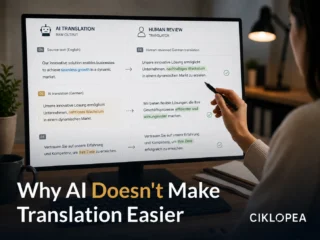
Artificial intelligence has dramatically reduced the effort required to create multilingual content. Organizations can now translate, adapt and generate content at a speed that would have been difficult to imagine only a few years ago. But greater production capacity does not automatically lead to better multilingual communication because it has also introduced an entirely new management challenge that most organizations have yet to recognize.

In today’s interconnected economy, the difference between companies that thrive globally and those that struggle often comes down to one critical factor: how they approach language strategy and localization planning. While many organizations still rely on intuition or outdated market assumptions, forward-thinking companies are embracing a fundamentally different approach—one powered by data, precision, and strategic insight.