
Why AI Does Not Make Translation Easier
 Ciklopea Consulting */ ?>
 Artificial intelligence has dramatically reduced the effort required to create multilingual content. Organizations can now translate, adapt and generate content at a speed that would have been difficult to imagine only a few years ago. But greater production capacity does not automatically lead to better multilingual communication because it has also introduced an entirely new management challenge that most organizations have yet to recognize.
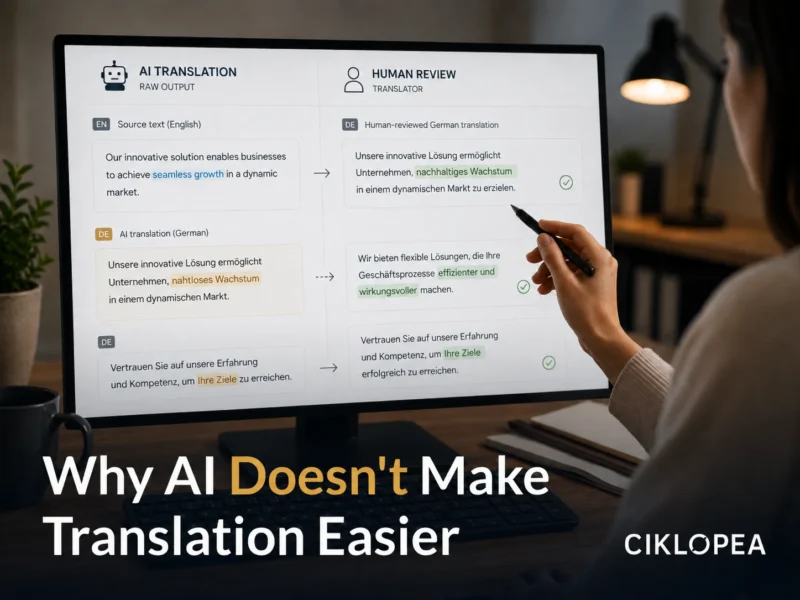
We Are Asking the Wrong Question
Much of the discussion about AI in the language industry still focuses on one question: Can AI replace translators?
It is understandable why this question receives so much attention. Generative AI and machine translation systems can already produce useful translations for many types of content.
But for organizations operating across multiple markets, this is not the most important question.
A more useful question would be:
How should we manage multilingual communication when AI can generate and translate content at unprecedented scale?
Consider a global technology company with a website, software interface, knowledge base, customer support operation and regular product releases.
Previously, the company might have sent defined batches of content for localization. Today, AI can translate new support articles immediately, generate localized marketing variations and help teams adapt product information continuously.
The challenge shifts from producing translations to deciding how those translations should be reviewed, approved and maintained. Hence, the role of LSPs in an AI-driven world is shifting from translation to risk management and trust.
AI Solved the Production Problem
Traditional localization workflows were relatively predictable.
Content was created, prepared for translation, translated by language specialists, reviewed and published. The process was usually organized around individual projects, releases or campaigns.
AI changes that model because content itself is becoming continuous.
A software company may update its interface several times each month. An eCommerce organization may add hundreds of product descriptions. A customer support team may revise knowledge articles every day. Marketing teams may use generative AI to create multiple versions of the same campaign for different audiences.
Producing multilingual content is therefore no longer necessarily the bottleneck.
The new bottleneck is decision-making:
- Which content should use AI?
- Which content requires human expertise?
- Which content must remain under strict governance?
- Who remains accountable for quality?
- How do we ensure consistency across hundreds of AI-assisted workflows?
Without clear answers, automation can simply accelerate inconsistency.
For example, if five regional marketing teams use different AI tools with different prompts and terminology, they may all produce acceptable translations individually. Across the organization, however, product names, technical terminology and brand language can begin to diverge.
Ironically, the easier content becomes to produce, the harder it becomes to manage responsibly.
Translation Is No Longer the Challenge
Many organizations still manage multilingual communication as a collection of translation projects.
That approach worked reasonably well when volumes were limited and localization happened at defined points in the content lifecycle.
It becomes increasingly difficult when multilingual content exists across websites, applications, product documentation, support portals, regulatory materials, internal knowledge bases and AI-generated content.
The questions organizations need to answer are therefore changing.
How should workflows be designed?
How should content be classified?
How should AI be governed?
How should quality be measured?
Which content requires traceability?
How should risk be managed?
These are not purely linguistic questions.
They involve process design, technology, quality management, risk management and organizational responsibility.
This is why multilingual communication increasingly needs to be managed as an operational capability rather than a sequence of individual translation requests.
Not Every Piece of Content Requires the Same Workflow
One of the most important principles of effective multilingual operations is simple:
Operational orchestration in the AI era means that different content carries different levels of risk.
An Instructions for Use document for a medical device can affect patient safety and regulatory compliance. A financial disclosure may create legal or reputational consequences if terminology is inaccurate.
A product description for an online store has different requirements. A short-lived social media post has different requirements again.
Using the same localization workflow for all four makes little operational sense.
AI makes this distinction even more important.
Imagine a manufacturer translating 5,000 eCommerce product descriptions. An AI-assisted workflow combined with terminology controls and targeted human review may provide an appropriate balance between speed, cost and quality.
Now consider the same manufacturer translating safety instructions for industrial equipment.
The potential consequences of an ambiguous warning or incorrect technical term justify stronger controls, specialist review and documented validation.
Once AI is introduced, applying the wrong workflow no longer creates isolated mistakes. It creates systemic risk at scale.
The Organizations That Will Succeed Won’t Use More AI
Another common assumption is that organizations with the highest level of automation will gain the greatest advantage from AI.
Experience suggests a more balanced approach.
The most effective multilingual operating models use automation where it creates measurable business value and human expertise where judgment, context or accountability matters.
Low-risk, repetitive content may be suitable for machine translation or AI-assisted workflows with automated quality checks.
High-visibility marketing content may require native linguists who understand tone, market expectations and brand positioning.
Regulatory, legal, medical or safety-critical content may require subject-matter expertise, structured review and full traceability.
The objective is therefore not to automate everything.
It is to establish a structured decision-making framework that connects:
- Business value
- Human expertise
- Governance
Finding the right balance requires a different way of thinking about multilingual communication – not as a language service, but as an operational capability.
Better Decisions Will Matter More Than Faster Translation
Organizations already measure capabilities such as cybersecurity maturity, digital maturity and AI readiness.
Multilingual operational maturity deserves similar attention.
International organizations increasingly depend on multilingual content to support customer experience, regulatory compliance, product adoption and international growth. As AI increases the volume and speed of content production, weaknesses in terminology management, workflow design and governance become more visible.
A company may be able to translate a product update into 20 languages within minutes.
But speed provides limited value if terminology differs from the software interface, legal requirements are overlooked or local teams spend days correcting the output.
The competitive advantage is therefore not simply faster translation.
It is the ability to decide what should be automated, what requires expert review, how quality should be measured and how multilingual content should be governed across the organization.
This Is Only the Beginning
Artificial intelligence has not removed the need for language expertise.
It has changed where that expertise creates the greatest value.
Language specialists increasingly work alongside technology, terminology resources, automated quality controls and integrated content systems. Their role becomes particularly important where context, subject-matter knowledge and professional judgment determine whether content is appropriate for its intended audience.
At the same time, organizations need stronger operational structures around multilingual communication.
The result is not AI instead of human expertise.
It is technology-enabled multilingual operations built around appropriate governance and specialist knowledge, which is exactly why machine translation paired with human post-editing still outperforms fully AI-driven translation.
Over the coming weeks, the Multilingual Intelligence Initiative will examine what this shift means in practice.
The next article will explore why treating every content type in the same way can become an expensive operational mistake, and why content risk should be one of the foundations of responsible AI adoption.
About the Multilingual Intelligence Initiative
This article is part of the Multilingual Intelligence Initiative, a Ciklopea thought leadership series examining how organizations can build responsible, AI-enabled multilingual communication capabilities.
Future articles will explore content risk, multilingual governance, AI operating models and the evolving role of multilingual communication as a strategic business function.