
Scaling AI Across Multilingual Content: The Biggest Mistake Organizations Make
 Ciklopea
Organizations often ask how much multilingual content AI can handle. The more important question is whether every piece of content should be handled in the same way.
Organizations often ask how much multilingual content AI can handle. The more important question is whether every piece of content should be handled in the same way.
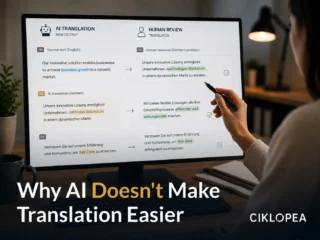
Artificial intelligence has dramatically reduced the effort required to create multilingual content. Organizations can now translate, adapt and generate content at a speed that would have been difficult to imagine only a few years ago. But greater production capacity does not automatically lead to better multilingual communication because it has also introduced an entirely new management challenge that most organizations have yet to recognize.

In today’s interconnected economy, the difference between companies that thrive globally and those that struggle often comes down to one critical factor: how they approach language strategy and localization planning. While many organizations still rely on intuition or outdated market assumptions, forward-thinking companies are embracing a fundamentally different approach—one powered by data, precision, and strategic insight.

As large language models (LLMs) like GPT redefine how we translate and communicate across borders, one persistent issue remains: AI still struggles with South Slavic languages — especially Croatian, Serbian, Bosnian, and Slovenian.

We’re excited to announce that Ciklopea will be part of ELIA Together 2025, one of the key events for language professionals!

In the fast-paced world of localization, maintaining the accuracy and quality of Translation Memories (TMs) is essential for ensuring seamless, consistent translations. As companies scale globally, the size of their TMs grows exponentially, which can lead to inconsistencies, outdated translations, and even redundant content. That’s where AI-powered TM Cleanup comes into play. This innovative solution combines the strengths of AI with prompt engineering, revolutionizing how organizations manage their TMs.

In the evolving landscape of artificial intelligence (AI) and machine learning (ML), the role of linguistic annotation has become more important than ever. As companies and developers work to build smarter systems, from chatbots to translation tools, the need for high-quality language data is paramount. But what exactly is linguistic annotation, and why is it so important?

We are thrilled to announce that our Managing Partner, Mladen Stojak, will be attending LocWorld51 in Dublin from June 5-7, 2024. This event is a key gathering for professionals in the localization and globalization industry, and we are excited to be a part of it.

In our previous blog post, we tackled the common pitfalls of translation and localization projects and programs. Now, let’s dive into how a streamlined 3-step process can turn these challenges into opportunities and drive your international expansion.

It’s a story that’s as old as time. Every time a new technology emerges, you have two groups of people. One group is excited about the potential applications and the other panics about the change ahead and potential disruption. AI in the translation industry has sparked similar reactions.

Recently, the Department of German Studies in Zadar hosted two workshops, organized in collaboration with Ciklopea. Our colleague Marijana was in charge of them for the third consecutive year.
Learn more about her insights regarding post-editing below.

Nowadays, artificial intelligence is the talk of the town. People across all industries are exploring how they can leverage AI tech to work more efficiently and optimize costs. We’re gradually pushing the limits of what’s possible, and the language solutions space is no different.

Ciklopea attended the Game Changer E-Commerce & Fintech conference on 4 December 2023, at Cukrarna in Ljubljana. With top lecturers and experts, the event explored trends in artificial intelligence, WEB3, cybersecurity, gamification, social media, SaaS, and marketing. Our team incorporates insights from industry leaders to continually enhance our localization solutions. Staying informed through conferences such […]

Ciklopea continues its commitment to staying abreast of industry trends and understanding client’s needs by actively participating in a range of exciting conferences. The company’s representatives Zana Čizmin, Chief Business Development Officer, and Marina Roček, Business Development Manager recently attended two remarkable events: Game Changer and CRO Commerce 2023. Game Changer 2.0 In Zagreb’s Z […]

We’re excited to present our latest instalment of Ciklopea Coffee Chat, featuring a captivating conversation with Manuel Herranz, CEO of Pangeanic.

Looking to expand your business globally and wondering how to tailor your products and services to local markets? Then you won’t want to miss our latest video interview with a localization expert, Josef Kubovsky, CEO at Nimdzi Insights.

Wherever you look nowadays, AI is the talk of the town. Just think about ChatGPT, DALL-E, or similar AI systems, and you’ll see why people are so divided when it comes to the direction in which the advancement of this technology will take us.

The 2022 European Language Industry Survey revealed an interesting finding: 35% of participating independent language service providers see Machine Translation (MT) as an opportunity and 41% see it as a threat. Translators’ relationship with technology – especially machine translation – has always been a complicated one.

We are pleased to announce that Ciklopea’s CEO, Sandra Boljkovac Stojak, will be one of the panelists at the Ladies of the AI Business conference, which will discuss the present and future of artificial intelligence and machine learning. As the organizers say, the AI revolution is already here! Although we still perceive AI as something […]

Our MD, Mladen Stojak, has recently been a guest on memoQ Talks, where he shared some of the stories behind Ciklopea‘s growth, transformation, organizational culture, and more.

Machine translation. Artificial intelligence. Neural language processing. Predictive modelling. These fancy terms have been flashing everywhere over the past several years to the point when it seems that all your localization problems can be solved with a double click. As of 2021, they can’t. In this article, we will try and explain the exact role of technology in the translation/localization process in the simplest possible terms and help you understand what it really can and cannot do for you.