

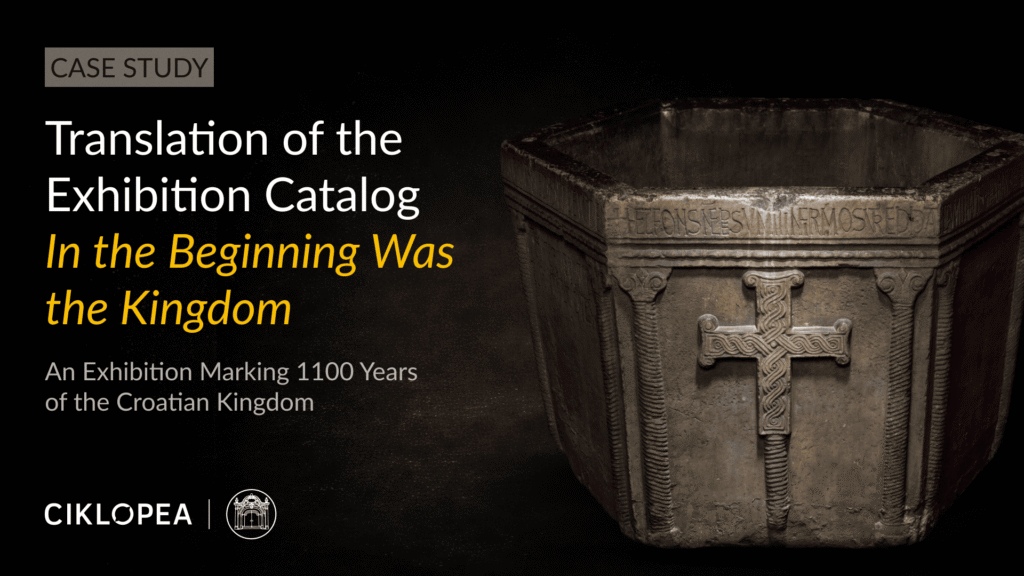
The exhibition catalog is a scholarly, interdisciplinary work that brings together a large number of authors: historians, archaeologists, art historians, and other experts. It is an impressive volume that has both a diplomatic and cultural dimension and is intended for an international audience. Ciklopea, which specializes in complex translation projects that demand a high degree of responsibility, was selected to work on the translation and linguistic adaptation of this publication.
The Challenges
1. A large number of authors and stylistic approaches The catalog included texts by numerous authors, each of whom had their own style, terminology, and type of scholarly discourse.The challenge was to standardize terminology, preserve the voice of each author, and ensure the coherence of the entire edition.
2. A wide spectrum of professional fields
The materials included historical and archaeological analyses, museum interpretations, descriptions of artefacts, curatorial concepts, and discussions of cultural and political contexts. Each field required terminological precision.
3. Cultural and symbolic significance
Celebrating 1100 years of the Croatian Kingdom is extremely significant, in terms of both symbolism and identity.
The tone of the translation had to maintain scholarly integrity, be stylistically elegant, communicate national significance, and be understandable to an international audience.
4. All of the original texts were in Croatian
All of the texts were created in collaboration with Croatian experts. This meant that the terminology was deeply rooted in the national historiographical discourse and that certain terms required additional contextual explanations in the translation.
5. Complex production process and deadlines
The catalog is part of an exhibition project with set printing and opening deadlines. The translation had to be precise, consistent, and delivered in time to meet the layout design and printing deadlines.
The Solution
1. Strategic team formation
Ciklopea formed a multidisciplinary team that included: a project manager (who coordinated the team and communicated between the authors and the linguists), translators specializing in history and cultural heritage, terminology experts, editors and style experts, native speakers of the target language, and final reviewers. The team worked in clearly defined phases with quality control points.
2. Terminology unification
At the beginning of the project, a terminological style manual (a tone of voice document) was created, with rules for the translation of specific historiographic terms. This ensured consistency across all texts, regardless of the number of authors.
3. Using tools and technological support
The project was completed using a professional tool, which enabled the creation of a translation memory, consistency in terminology, version control, and faster collaboration between team members. Given the scope and importance of the project, a centralized translation memory and terminology database was used to ensure that all translators were working within the same system.
4. The role of native speakers
Due to the importance of tone and with an international audience in mind, the final stages of the project involved native speakers of the target language who adapted the text stylistically, ensured natural expression, eliminated possible interference from the source language, and maintained the academic level of the discourse. This ensured that the catalog did not read like a translation, but as a work written in the target language.
5. Multi-stage quality control
The process included: translation and proofreading by a native speaker, terminology checks, revision by the author of the source text, and final proofreading before printing.
Each stage had clear quality criteria, with continuous communication with the client being key. This included:
- Recording feedback from the authors of the texts – all amendments to the source text during the project or the translated text during revision had to be recorded in real time across all our resources (translation memories, terminology databases, and the style manual) to ensure consistency.
- Conveying feedback from the chief editor to the authors during the final review of the text.
The Result
A uniform, stylistically consistent catalog, which preserves scholarly precision and authorial integrity, and which communicates clearly and comprehensibly with an international audience. Terminological consistency across hundreds of pages, and timely delivery aligned with the printing deadlines and the opening of the exhibition.
The catalog successfully presented Croatia’s historical heritage to a global audience and served as a lasting record of this national cultural jubilee.
Ciklopea’s Added Value
This project demonstrates Ciklopea’s ability to manage complex cultural and scholarly projects, coordinate larger translation teams, ensure a high level of terminological and stylistic precision, integrate technology and human expertise, and understand the importance of cultural context and national identity.
In projects with high symbolic and professional significance, translation is not just a technical process – it becomes an act of cultural mediation.