
Word Drift and Language Loop in the Age of AI: What It Means for Multilingual Communication
 Ciklopea Consulting */ ?>
 Language is a living matter. It changes within the same culture, influenced by different jargons and social, political, or historical movements. The age of AI is making these changes faster and more significant.
At this moment, we might be witnessing the most fascinating moment in the history of language: the shift in which machine translation is taking over localization and translation services. In other words, AI translation services have become the backbone of the global translation industry.
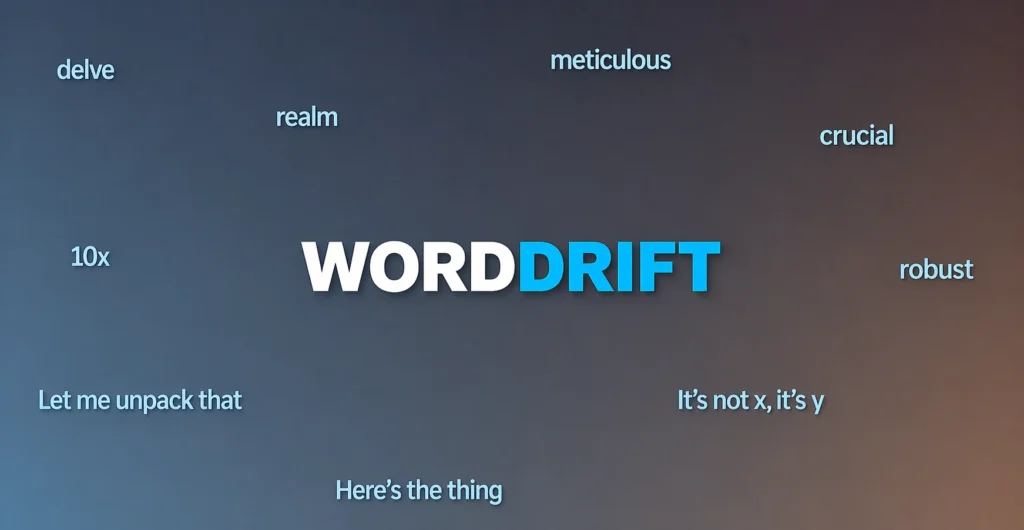
Within these fast changes, one of the most important trends is the word drift: a gradual change in how a certain lexeme is understood and localized. It may refer to other linguistic features than mere lexemes. For instance, if you expected another verb in the sentence above, in addition to understood and localized, it means that your mind has already been accustomed to this string of three, commonly used in AI-generated text.
Within the AI revolution we’ve been witnessing in the last few years, AI-generated language feeds back into human language.
The language industry experts are aware of these changes. Many of us are already working on systematic solutions that would utilize AI for the benefit of translators and clients while preventing errors and avoiding misuse of AI translation services. It’s important to highlight the term systematic because ML systems we’ve built to generate language now increasingly shape it; not only one language, but numerous languages.
At the GALA World Ready Conference in Berlin, held on 12-14 April 2026, word drift was explicitly mentioned during the keynote speech. That idea has stayed with me even after the event as something that deserves some additional explanation, as something deeply consequential for translators, localizers, and transcreators.
Still, this word drift comes with certain risks, embedded in the terminology drift, compliance implications, and consistency vs. nuance interplay.
What is Word Drift?
Word drift is a gradual change in the way lexemes, idioms, and linguistic structures are used over a time interval. Before the AI shift, word drift typically happened via human interaction, culture, and geography. Those were the natural influences that used to form language patterns.
Today, however, AI tools generate incredible amounts of documentation, business correspondence, marketing content, and niche-related text. Given the vast amount of language data that AI tools have been fed with, machines now influence language in a subtle but powerful manner.
The AI-enhanced word drift is especially visible in regulated industries, documentation-heavy surroundings, and multilingual workflows. These fields have been more exposed to and inclined to machine translation, mostly because they contain more formulaic expressions than some other language environments.
Based on our 20+ years of experience in the translation industry, we know that increased risk that affects translation consistency may lead to compliance issues. Still, we are here to cover all the bases that would reduce such risks and provide the best possible service to clients.
What Are We Already Seeing?
From a practical, day-to-day perspective, several patterns are emerging:
- Increasing use of standardized, “safe” phrasing
- Repetition of certain sentence structures
- Neutral, flattened tone across different contexts
- Reduced stylistic and regional variation
- Convergence toward globally understandable language patterns.
Under the influence of the language patterns generated by AI tools, people now increasingly use phrases and lexemes that sound like artificial language. They don’t do it on purpose, though. The exposure to such content leads to massive use of AI patterns.
A Shift in How Language Evolves
Ever since humankind started to speak, language has evolved through people.
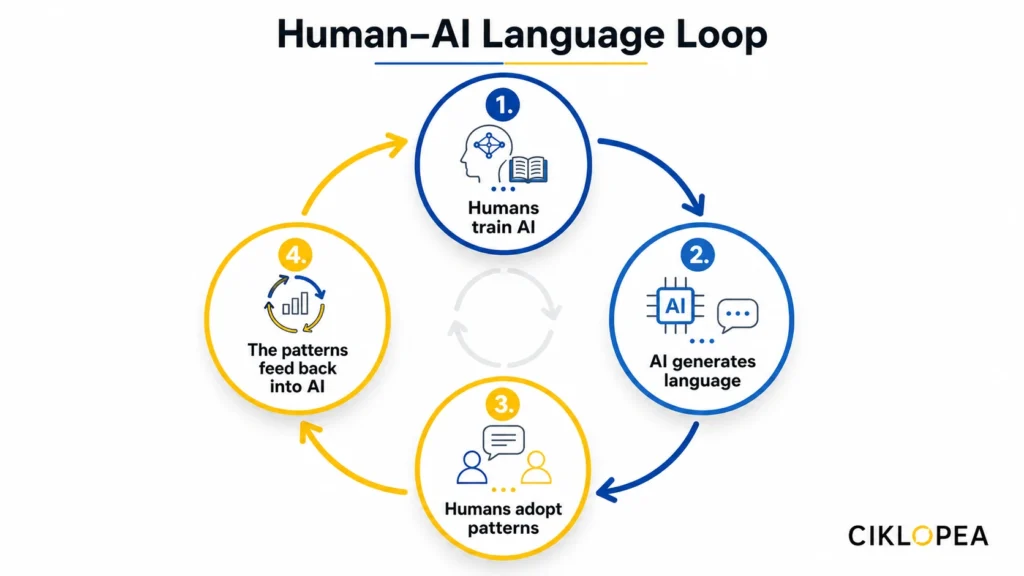
This is the first time in history that it evolves through a feedback loop:
Humans train AI → AI generates language → Humans adopt patterns → Those patterns feed back into AI.
Trapped in a language loop, people start sounding more like robots. It doesn’t have to necessarily be a negative thing in everyday communication. Apart from stylistic issues, it most commonly won’t lead to any dramatic outcomes.
In the context of translation and localization services, repetitive, robotic text can cause serious damage. Take, for instance, the translation field of IFU services (instructions for use). A mistranslated AI translation could harm someone’s life. That’s why the translation industry must treat word drifts and language loops with special care.
Impact on Multilingual Environments
In multilingual contexts, the growth of systematically robotised language causes bigger changes.
As new language patterns are introduced, they are further replicated across different languages. For instance, a misinterpreted medical term from English enters Spanish. When it’s repeated frequently enough, the new meaning outshadows the old, more reliable one. Through AI translation tools, this improperly translated term may spread to, say, Chinese, causing confusion in another market. It would be the real game of Chinese whispers, but in a field of work where such mistakes can be fatal.
It’s fair to say that machine translation can help improve consistency and increase the production rate. We’ve had Trados for decades now. Such tools have made our profession easier through a certain level of automation. It’s easier to align across various markets with the assistance of AI tools.
Impact on Regulated Industries
Some industries are less immune to such sudden changes in the way translation is carried out. Life sciences language services are among the most AI-sensitive niches out there. Medical devices and pharmaceuticals follow it closely. Such industries heavily rely on precise terminology and consistency among documentation for operational and compliance reasons. What’s more, the traceability of changes and the alignment between language and regulatory intent play a vital role in these translation fields.
Small shifts in phrasing can lead to:
- Inconsistencies across IFUs, software, and regulatory documentation
- Misalignment between markets
- Increased review cycles
- Potential compliance issues.
As AI tools enable faster scaling, they also accelerate the impact of those inconsistencies.
On the other side of the spectrum, we have the marketing and content industry, or e-commerce localization services. Saying that AI-enhanced translation and localization have been one of the key factors in global e-commerce would be an understatement. Nevertheless, even in such less risky niches, human translation services and editing are still vital translation and proofreading methods.
What This Means for Companies
Organizations working in different language markets and within various legislative contexts must adapt to the word drift, language loop, and other phenomena..
This adaptation consists of the following features:
- Stronger terminology governance
- Controlled workflows
- Clear quality frameworks
- Defined roles between AI and human expertise.
Every bit of content translated, localized, and edited at translation companies requires an extra dose of human management. This approach guarantees that the final product isn’t an AI slop that can put people’s lives in harm’s way.
From Standards to Safeguards
Apart from ensuring the uncompromising quality of core tasks, translation companies must introduce and follow structured approaches in terms of regulatory requirements.
Frameworks such as ISO 13485 and ISO 18587 are some of the international standards that every company, regardless of its industry, should implement. But what is ISO 13485 in the first place? ISO 13485 is a standard for quality management in the medical devices industry. Every provider of translation services in the medical industry, pharmaceuticals, and life sciences should possess this certificate.
On the other hand, ISO 18587 is an ISO standard that defines the requirements for post-editing of the machine translation output. This standard is one of the most important niche-narrow ISO standards for the translation industry. Together with ISO 27001, these are all the necessary ISO standards for competitive, legal, and smooth translation services, especially on a global level.
From a security point of view, these standards are the safeguards that provide control where scale increases risk. Also, possessing such international standards increases the organisation’s competitiveness.
A Shift Worth Paying Attention To
After more than 20 years of dedicated work with multilingual content, I feel that we’re entering a whole new era. Under the influence of AI, language is now shaped both by human interaction and machine language systems. In addition to being translators, editors, proofreaders, and transcreators, we now have to expand the list of our duties to include careful examination of AI-translated and AI-generated content.
If we can use a famous movie phrase at the end of this insight: AI you talking to me? Are we starting to speak like AI, or is AI starting to imitate us?
Have you noticed certain phrases becoming more “standardized” in your communication?