
Technical Translation Services: How Manufacturers Can Reduce Errors, Costs and Time to Market
 Ciklopea Consulting */ ?>
For manufacturers selling across borders, technical document translation services help keep specifications, operating procedures, and safety information accurate in every required language.
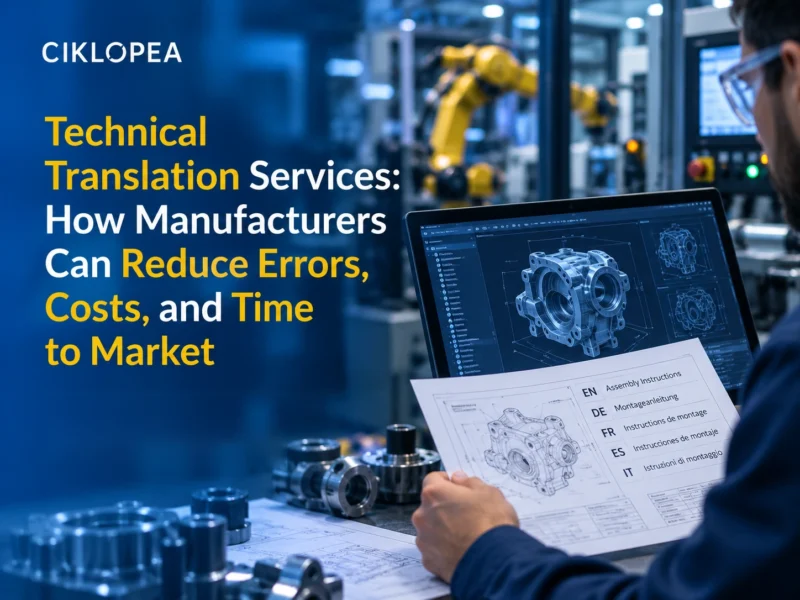
From user manuals and consumer policies to technical documentation and multilingual localization, language service providers (LSPs) may cover a wide range of technical translation services.
This article explains which materials need specialist attention, how translation affects production costs and launch schedules, and what to look for when choosing a language service provider for your manufacturing business.
1. What Are Technical Translation Services?
Technical translation services refer to the activities carried out to transfer the meaning of technical content from one language to another one or several other languages. T
Organizations providing technical document translation services typically work with experienced and specialized technical translators who fully understand the given industry. What’s more, niche experts and/or editors must verify the final version of the technical translation. Only such a complete product is to be submitted to the client.
2. Which Manufacturing Documents Need Specialist Translation?
Some industries are more demanding than others when it comes to translation. For instance, translating an article about the languages of the world requires some sort of expertise. However, the risk that someone’s life will be in danger if a term is mistranslated in this niche is very low.
On the other hand, professional technical translation services carry greater risks in case of translation errors. Translating software documentation, mechanical engineering instructions, financial reports, life science materials, or chemical research all require a high level of niche knowledge and translation experience.
In those fields, only one inaccurate word may lead to disastrous outcomes, such as fatalities, financial losses, and damaged brand reputation. In other words, translation services for technical documents demand a special level of professionalism and attention. Compared to everyday translation services, fewer translation providers are equipped and experienced enough to guarantee this level of quality.
As business pace accelerates, providing spotless technical translation on time is becoming harder. Still, there are certain steps and methods that help language solution providers increase their chances of meeting the professional criteria for accurate technical translation.
3. Subject Expertise, AI Tools, and Quality Checks Reduce Translation Errors
In technical manual translation services, subject expertise and quality checks are the key prerequisites for reducing translation errors and submitting spotless work. What does this mean in practice, especially in this AI-driven era?
The extent to which machine translation will be used depends on the technical lingo of the given industry. For instance, in marketing and corporate translation, it’s more likely that AI translation software will make fewer mistakes than in technology and manufacturing translation.
The main ground for this reasoning lies in the complexity of the niche in question. A general marketing and corporate guide or case study typically contains fewer technically complex concepts than a tech or manufacturing translation. We tend to complain about how dry and impersonal AI-generated text is, especially in the area of corporate communications. But artificial intelligence didn’t invent this jargon. It has been corporations playing safe, language-wise, for decades. AI now imitates what’s been part of the general business discourse for a long time.
On the other hand, localizing user manuals is a completely different sport. Only one mistranslated word or item may lead to fatal mistakes in a manufacturing process. This is where the role of human translators, proofreaders, and editors (not necessarily all three within the same person) becomes a vital position. When an experienced industry translator or a niche expert specialized in quality control checks the translation, the risk of translation errors is reduced to a minimum.
4. How Consistent Terminology and Translation Memory Control Costs
Manufacturers often repeat the same instructions, component names, and safety warnings across their documents. In multilingual translation, inconsistent terms often mean additional questions and corrections in every target language. Hence, defining a glossary before work starts gives translators approved terms for each language and saves everyone some trouble later. Translation memory helps with repeated content. It saves previously translated segments, allowing translators to reuse them when the same or similar wording appears in another document. For instance, a revised machine manual may contain only a few new instructions. There is no or little point in translating the unchanged sections from scratch. Reusing approved content can reduce translation costs and the time spent reviewing familiar material. Still, translators must check whether each stored segment fits the current context, especially when equipment specifications or operating procedures have changed since approval. In such cases, it’s recommended that the client for whom the translation has been carried out lends their subject experts to the language service provider so they can establish the most efficient workflow.
5. How to Plan Technical Translation for a Faster Product Launch
Planning the entire technical translation process both in-house and through consultations with the client may reduce costs and decrease the risks of late or inaccurate translation.
For a language service provider, preparing technical documentation for a product launch starts with understanding the manufacturer’s schedule. We need to know which markets the product is entering, what materials require translation, and when each document will be ready.
Waiting for the final files before discussing these details leaves less time for questions, expert review, and layout checks. Agreeing on the workflow early helps us organise the work around product development and handle revisions as engineers finalise specifications and instructions.
- Translate in stages: Start with approved sections while others are being drafted, rather than waiting for the complete documentation package.
- Resolve questions together: Establish a contact within the manufacturer’s engineering team who can clarify ambiguous instructions before they delay translation.
- Prioritise launch materials: Agree which documents must accompany the product at release and which supporting materials can be delivered afterwards.
6. How to Choose Translation Services for Technical Documents
Choosing professional technical translation services starts with asking how the provider handles documents like yours. Relevant industry experience matters, but so do translator qualifications, independent revision and clear responsibility for corrections. A reliable LSP should explain these steps before the project begins. At Ciklopea, we support this work with documented procedures and internationally recognised certifications, giving manufacturers a concrete basis for assessing how we manage translation quality and confidential information.
Our five ISO certifications cover different aspects of service delivery. ISO 9001 addresses quality management, while ISO 17100 sets requirements for translation services. ISO 27001 governs information security, and ISO 18587 covers human post-editing of machine translation output. ISO 13485 strengthens our quality management for services supporting medical device manufacturers. Together, these standards help us compete internationally through independently audited processes.
For clients, this means defined responsibilities, traceable work and documented controls for protecting information and handling quality issues consistently.
Conclusion
Manufacturers need translated documents that engineers, operators and customers can trust. Clear source material, consistent terminology, and experienced translators are the starting point. Independent review helps catch mistakes, while reusing approved translations reduces repeat work. Planning translation during product development leaves time for questions and revisions. Together, these steps help control documentation costs and keep international product launches on schedule.
Ciklopea has been providing technical translation services for more than twenty years, successfully shifting into the digital age. Our work combines the best of machine translation and human work to deliver accurate technical translation to our clients in a timely manner. Reach out to get your tailored quote and become one of Ciklopea’s satisfied clients.