
 AI for faster and more affordable translations
Scaling AI Across Multilingual Content: The Biggest Mistake Organizations Make
 Ciklopea
Organizations often ask how much multilingual content AI can handle. The more important question is whether every piece of content should be handled in the same way.
There’s a lot of skepticism surrounding AI translations. We’re here to tell you that machine translation has its place in the localization ecosystem.

–
–
–

 MT boosts the productivity of translators by up to 60%
The combination of machine translation and advanced artificial intelligence systems allows translators to speed up their translation process.
An average translator at Ciklopea can translate between 2000-2500 words per day without any help from MT. Imagine how much faster turnaround times could be if we let machines do the heavy lifting?
According to our calculations, somewhere between 50-60%.
 Quickly translate repetitive content
From manuals and user guides to privacy policies and other uniform legal documentation, you’re dealing with projects that require a lot of repetitive work.
With MT, translators don’t have to start from scratch. They can post-edit the content and do quality assurance so everything is ready much faster than it would be if they weren’t using tech.
And what does this mean for you? Lower costs, faster translation turnaround, and better translation quality.
 Balance costs by dedicating more attention to complex projects
AI translation is not the optimal solution for every type of project. For example, if you have marketing materials or long-form SEO content, then human translation and transcreation might be needed.
However, with machine translation and AI, you can cut costs where human post-editing is sufficient and then allocate the remaining resources to more complex projects.
Let us know what type of project you need help with, and we can advise you on the best way to proceed.
We thought so. Let’s talk and see if we’d be a good fit.
Organizations often ask how much multilingual content AI can handle. The more important question is whether every piece of content should be handled in the same way.
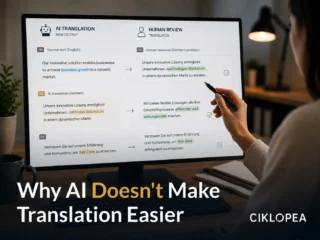
Artificial intelligence has dramatically reduced the effort required to create multilingual content. Organizations can now translate, adapt and generate content at a speed that would have been difficult to imagine only a few years ago. But greater production capacity does not automatically lead to better multilingual communication because it has also introduced an entirely new management challenge that most organizations have yet to recognize.

In today’s interconnected economy, the difference between companies that thrive globally and those that struggle often comes down to one critical factor: how they approach language strategy and localization planning. While many organizations still rely on intuition or outdated market assumptions, forward-thinking companies are embracing a fundamentally different approach—one powered by data, precision, and strategic insight.