
Scaling AI Across Multilingual Content: The Biggest Mistake Organizations Make
 Ciklopea
Organizations often ask how much multilingual content AI can handle. The more important question is whether every piece of content should be handled in the same way.

The main phases of our translation/localization process.
Professional experience has shown that quality of service depends on all stakeholders in the business process – employees, suppliers and management.

Download the certificate (PDF, 2 pages, English, 220 kB)
The ISO 17100:2015 international standard establishes and defines the requirements for the provision of quality services by translation services providers. It covers both the translation process and all other aspects relating to the provision of services, including:

Download the certificate (PDF, 2 pages, English, 461 kB)
The continuous success of an organization requires the systematic, documented management of process quality and the establishment of grounds and prerequisites for improvement.
The ISO 9001 standard is the most prevalent international standard, focusing on establishing and maintaining quality management systems. The requirements of the standard address the basic processes within an organization, from sales, development, purchasing, production and rendering services to measuring, controlling and monitoring during the delivery of products and services.

Download the certificate (PDF, 2 pages, English, 491 kB)
ISO 27001:2022 is the basic standard for information security management in any type of organization. Its application provides a process approach for establishing, implementing, monitoring, reviewing, maintaining and improving the information security management system. In addition to a comprehensive, detailed approach to protecting and securing information as the intangible assets of an organization, it stipulates controls and ways of protecting material assets such as computers or computer networks.
The implementation of the information security standard ensures confidentiality, which means that business information is accessible only to those for whom it is intended. It also ensures access to information by authorized persons whenever it is needed, as well as the accuracy and completeness of information.
ISO 27001:2022 is fully compliant with quality management systems such as ISO 9001.

Download the certificate (PDF, 1 page, English, 784 kB)
ISO 18587:2017 provides guidelines and requirements for the post-editing of content that has been generated by machine translation systems. Post-editing involves human translators reviewing and improving the output produced by machine translation engines to ensure the quality, accuracy, and fluency of the final translated text. ISO 18587 establishes a framework for collaboration between human translators and machine translation systems, defining the competencies and qualifications required for post-editors.
This ISO standard covers:
With full MT post-editing, language experts ensure that the translated text is of a quality equal to that provided by a human translator. With light MT post-editing, we make light changes to produce an accurate and understandable translation without entering too deeply into the translation (e.g., no localization or focus on style and tone of voice). Both have their advantages and their place in different projects.
ISO 18587:2017 is used by language service providers, their clients, and post-editors.
Organizations often ask how much multilingual content AI can handle. The more important question is whether every piece of content should be handled in the same way.
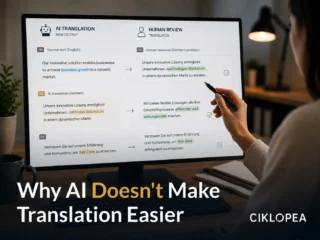
Artificial intelligence has dramatically reduced the effort required to create multilingual content. Organizations can now translate, adapt and generate content at a speed that would have been difficult to imagine only a few years ago. But greater production capacity does not automatically lead to better multilingual communication because it has also introduced an entirely new management challenge that most organizations have yet to recognize.

In today’s interconnected economy, the difference between companies that thrive globally and those that struggle often comes down to one critical factor: how they approach language strategy and localization planning. While many organizations still rely on intuition or outdated market assumptions, forward-thinking companies are embracing a fundamentally different approach—one powered by data, precision, and strategic insight.